On my recent walking tour of radical Dublin, one of the places I brought people was to the site of the Irish Farm Produce Company restaurant and shop on Henry Street. It was there that the 1916 Proclamation was signed, and indeed the premises was the ‘radical cafe’ of its time. Interestingly, most of the people on the tour had not noticed the plaque marking the location of the premises before. It truly is an unusual Dublin plaque.
The plaque to Captain Thomas Weafar on the corner of Lower Abbey Street is another prime example of a plaque many Dubliners are unaware of.
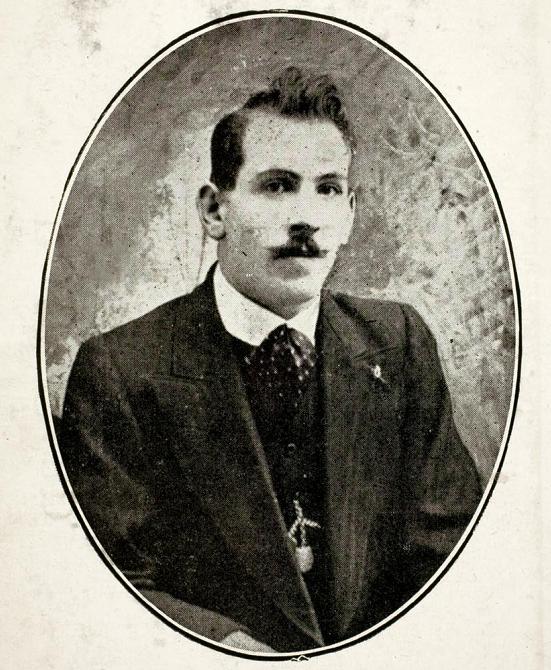
Captain Thomas Weafer ( The plaque reads Wafer, however as you will see below Weafer is more commonly found when discussing him) was shot and killed on Wednesday April 26 1916 while occupying the Hibernian Bank on the corner of Lower Abbey Street and Sackville Street. The strategic importance of the building is clear. It allowed Weafer and his men to control access to the street from Amiens Street Station for example, and members of the the GPO Garrison were occupying a number of buildings on each side of Sackville Street.

Meda Ryan wrote about the experiences of Leslie Price (who went on to marry Tom Barry), in her study of the famous Cork rebel leader entitled Tom Barry: IRA Freedom Fighter.
Receiving no orders, like many Cumann na mBan activists, Leslie headed for the G.P.O
Initially they cooked meals and helped the men in the Hibernian Bank. On Tuesday forenoon the building came under attack from British troops. Leslie was standing beside Capt. Tom Weafer, OC of the Hibernian Garrison, when a bullet whizzed past her and into his stomach. As she was about to attend to him another bullet lodged in the chest of the man who had gone to Capt. Weafer’s aid. She had just time to say a prayer in Weafer’s ear when he died.
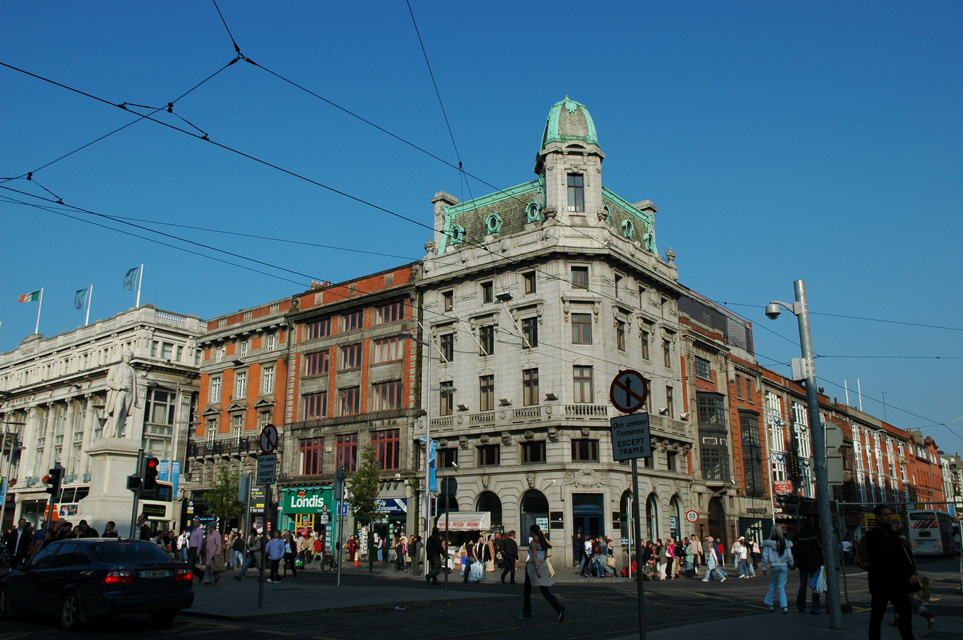
From tropicalisland.de, the building on the corner of Lower Abbey Street and O' Connell Street is the old Hibernian Bank premises
The Rebellion Handbook published in 1916 by The Irish Times gives the following listing for Weafer:
Weafer, Thomas, was a captain in the Irish Republican Army, and belonged to Enniscorthy, where he was born twenty-six years ago. He was killed in the Hibernian Bank at the corner of Sackville Street and Lower Abbey Street, on Wednesday 26th April.
Weafer is refered to as Thomas Wafer in an entertaining piece from ‘Sceilg’, the pen name of choice for John Joseph O’Kelly. In his piece The GPO, now widely available within the recently republished Dublin’s Fighting Story, he wrote that
At the Hibernian Bank, Lower Abbey Street, Captain Thomas Wafer of Enniscorthy died of terrible wounds, at the age of twenty-six, the place in which he fell being soon shrouded in flames
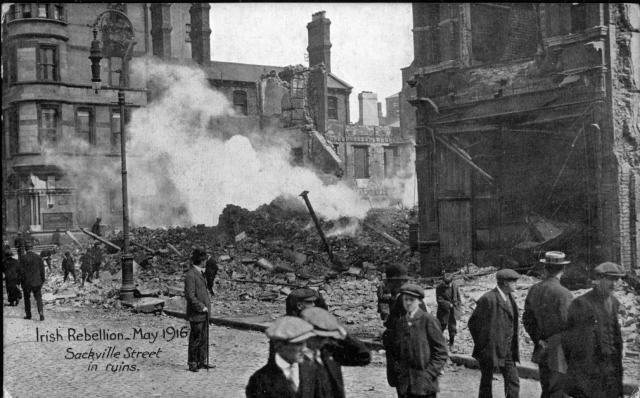
The body of Thomas Weafer was never recovered, lost to the fire that destroyed the premises . Some idea of the ferocity of the fires that broke out on Sackville Street during the insurrection can be obtained from the Bureau of Military History Witness Statement of Oscar Traynor (W.S 340) who remarked that
Some time on Thursday a barricade which stretched from the Royal Hibernian Academy to a cycle shop- I think the name of it was Keating’s, on the opposite side of the street, took fire as a result of a direct shell hit. It was the firing of this barricade that caused the fire which wiped out the east side of O’ Connell St. I saw that happen myself. I saw the barricade being hit, I saw the fire consuming it and I saw Keating’s going up. Then Hoyt’s caught fire, and when Hoyt’s caught fire the whole block up to Earl St. became involved. Hoyt’s had a lot of turpentine and other inflammable stuff, and I saw the fire spread from there to Clery’s. Clery’s and the Imperial Hotel were one and the same building, and this building was ignited from the fire which consumed Hoyt’s (…..) I had the extraordinary experience of seeing the huge plate-glass windows of Clery’s stores run molten into the channel from the terrific heat.
The National Graves Association unveiled a plaque to Captain Thomas Weafer on Easter Sunday 1936. Notice the Weafer spelling is used on the contemporary site, while the plaque reads Wafer.
Weafer was a married man who was living in North Dublin at the time of the insurrection. Today, a street in his hometown of Enniscorthy is named after him (Weafer Street) and the plaque to his memory remains. While partially obstructed by a newspaper stall, this plaque remains readable to the passing public. It is, like the earlier linked-to plaque marking the spot of the Irish Farm Produce Company premises, an important site of the 1916 Rising marked.

 Click on the book for more.
 Click on the book for more.


 Come Here To Me!
[…] Here to Me! with another lovely post on Dublin history that may have passed you by… or that you may pass by. This time on the man to whom a little plaque on O’Connell […]
Spotted this on The Story, nice little tale. Pissing rain today and I was on the far side of the street, but tomorrow I’ll check this one out. might be worth asking the guy to move the newspaper stall?
I stumbled upon this article and am interested in Thomas as he may be my great grandfather. Does anyone know who his was wife or kids were?
His wife was Margaret Hanley (1883-1944) from Galway. I believe he only had one child, a daughter, Mary Elizabeth Wafer born October 29,1913.she married William Burgoyne
August 31,2931at St Joseph’s Church in Galway.they had
One daughter not sure if more children. He name is Moira
She married Mike Riddick or Ridding( I have seen it written
Both ways; good luck!
I believe my father Francis Wafer (who died in 1971in Sussex England) was related. An Enniscorthy man himself who did not reveal anything about family or his background. After being fed by the British press while I was growing up I looked on my father & the IRA as the bad guys.After visiting Wexford/ Enniscorthy as an adult I wanted to see the other side of the “argument”& can totally understand why the British are hated so much.
My father was a good man who broached the subject on how they were “kept down ” but never gave me a one eyed version!
I know now if I had been living in Ireland during my teens I would have been in the thick of it.
I hope that the Irish get what they want as they derserve it for all their sacrifices.
Too be honest I’m ashamed to be British
Hello Sean,
My fathers family originated in Wexford but moved to Dublin. I understand what you mean about the history, it is all very sad.
Hello Sean.
I have just read your moving piece about Francis Wafer. I have recently discovered you could be my half brother. I was adopted as a baby and recently been researching my birth family. My father was Francis Wafer who lived in Finchley at the time of my birth. Last week I went over to Ireland to meet Kevin Lee a 2nd cousin and he referred me to this sight. Would love to here from you maureen.
My mum was from Enniscorthy (her name was Ann Wafer (people called her NAN). I don’t know too much about her family and background. If somebody reads this and knows of my mother’s family I would love to hear from them.
I am her youngest daughter – I have 3 sisters and 1 brother (all living in England). Mum has been dead now for 13 years (this November 13th). She was a kind and gentle soul and I believe she missed “home” very much throughout her life in England.
There’s not a day goes by that I don’t think about her.
Thank you.
Ann
Don’t know if you will see this 8 years later! My grandfather George Wafer was younger brother to Captain Thomas Wafer. One of their younger brothers, Patrick married Anne Meaney hence Anne Wafer. I know she wasn’t your mother but she may have been related. Anne died in childbirth in New York in 1927. She had a son Patrick Jr in 1926. Patrick Jr had a son around 1956 named Patrick in Montclair NJ.
Hi Ann, I’m looking for information on Ann Wafer who lived in Stepney with George Victor Gregory in the 1950s and 1960s. I believe she was born in Enniscorthy in 1919. Any help would be appreciated.
Hi Roy
Ann was my mum and I grew up in Stepney Green. My Dad was George Gregory. Mum had five children the second eldest June sadly passed away last year.
My da was from ringsend n all his bros n sis 2 thomas weafer was my das uncle but sadly my da has passed on but my das bro was named after thomas weafer my uncle thomas lives in bath ave n all the weafers wer called wafers at one stage
hi sean thomas weafer here my grandad lived in gorey . id love to know about the klan . there were “men” good ones . thanks. TOM
We have done some tracing of the Weafer family and on a visit to Enniscorthy – actually parked on Weafer street by coincidence! Also found the memorial section to Captain Thomas Weafer in museum.
Hi Karen
I am a great great grandaughter of Captain Weafer and would love to hear from you, a lot of family still around the wexford area.
Excellent post! A friend told me about that plaque several years ago and I photographed it. Last year I posted the pics on the Famous Wexford Natives page on Facebook, and now I’ve added a link to this post. Great to get some more information about him.
There is actually a second plaque in Irish hidden behind the left end of the newspaper stall.
My Wafer great grandfather, George Alexander, emigrated from Ballycogley in South Wexford to Bermondsey in London around 1878. His father John was from “Queens County” now Co. Laois. So I don’t know whether our branch is directly related to the Enniscorthy Wafers. Given the rarity of the name there is probably a distant connection somewhere.
Wafer and Weafer appear to be just two alternative spellings without any great significance. The plaque says Wafer, and the community centre in Springvalley Enniscorthy named after him seems to be officially spelt Captain Wafer Hall (I would like to see a photo to confirm this), even though the Street in the town is Weafer St.
The plaque to Capt Thomas Weafer is being re erected on Sat 4th April 2015 at 11.30
Seamus, can you tell me where they erected the new sign? Thank you.
Do any you know if Thomas Weafer received a 1916 arm band?They were issued to survivors of the 1916 Rising in 1935.
Rosefrances
I do not anything about his children but I am related to him through my grandfather Thomas Weafer he was born in Enniscarthy but then lived in Dublin. He emigrated to America in about 1922
He is my mother’s cousin, my mother is Elizabeth (Monica) Askins, from Enniscorthy
HI Rosefrances here. To find out if Thomas Weafer or his decendents received a 1916 arm band the family need to contact the Army Commeration Committee at Renmore Barracks in Galway. They will only give out information to immediate relatives.
My Grandmother was Margaret Wafer/Weafer lived and died in the Shannon buried in Enniscorthy cemetary
Married Michael Askins my grandfather. His father and mother were William Askins and Catherine Murphy.
Captain Thomas and Paddy both in the 1916 Easter Rising were her brothers. After Paddy’s release from jail (how he got there and when released I don’t know) he was sent by Michael Collins to America (after the War of Independence 1916) to organise gun running between the U.S. Hamburg and Ireland he remained there until 1922.
My Grandmother’s parents were Thomas Weafer (1833-1911) married Elizabeth Fallon lived at Tomnalosset, had large family. Thomas died in the Shannon buried in Enniscorthy.
Patrick Wafer, my grandmother’s brother, (a local councillor) married Dorah Keegan daughter of George and Catherine Keegan another Republican family. They are shown in the 1901 census as living in the Shannon with their children Thomas , Mary, George, Patrick and John.
Later John lived in Westport
George in New York
Her (Dorah Keegan’s) brother George was local Head Centre of the IRB before his untimely death at 41.
Another brother Thomas was a Fenian and was arrested in Enniscorthy in 1916 aged 76 and deported to Stafford jail.
The Keegans had been prominent in the struggle for independence for many generations. One being hanged aged 19 at Carnew in 1798. A grandson Patrick Keegan was Commandant of North Wexford Brigade I.R.A. Patrick was one of the leaders of the Rising in Wexford. it was at the Keegan home in Irish Street Enniscorthy that the Volunteer leaders of the County gathered during the Easter Week to discuss plans and it was from the same house they marched on the Thursday of Easter week to seie the town and hold it until the surrender.
The families Roche and Deady were related by marriage.
UPDATE – a second cousin of Captain Thomas – a judge Tom Travers also a republican was tragically shot by the IRA in 1986, in spite of 6 direct hits, he survived and died Boxing Day 2010. His daughter Mary aged 21 was shot and killed by the same person. When you see what the family had sacrificed for the “cause” over so many years, its a sorry tragedy that this should have happened. The perpretrator was never brought to justice for this heinous crime in spite of being identified by Tom’s wife.
Hi Ina.
My name is Thomas Weafer. I am the grandson of Captain Thomas Weafer’s brother Patrick “Paddy” Weafer. His son Patrick…my father…was born in New York City in 1925. I was born in Montclair, New Jersey in 1954. My father named me in honor of Captain Thomas Weafer.
Tom Weafer
Tom,
I have done a study of Captain Thomas Wafer that you may be interested in (August 2012). I would be delighted to share it with you should you arrange to send me your email address.
Thomas I am the granddaughter of George Wafer brother to Captain Thomas and your grandfather Patrick. My father and brother are both Thomas Wafer. Your grandmother Ann Meaney Wafer died May 13, 1927in childbirth. She and her child are buried with my grandparents, George and Lucy Wafer In section 35 of Gate of Heaven cemetery, Hawthorn New York. She is not marked on the grave stone. Your father and grandfather lived for a time following your grandmother ‘s death with George and Lucy and their 4 children in New York City. George died in June 1951, Lucy, July 1960. Hope you read this so we can follow up.
Ina,
Thanks for your note today. There was not a reply icon opposite it so I am replying to your initial note above. You obviously have a lot of family information and I was particularly interested in your Update. I would be very happy to forward what I have to you and would only ask that you send it forward to any family member you wish. I presume you can ask the owners of this blog to send your email address to me. Any feed back on my study would be welcome.
Regards,
Mark
Mark,
Thank you for your e mail.. you can email to me on ina644@btinternet.com. All the information by the way comes from my mother Elizabeth Askins (Jones) who is not that confident on the internet so I am passing on information for her.. she is thrilled with any news, so thank you. We will definately pass on feedback.
Thank you Ina for your post. I am a Keegan from South Dublin and am very interested in discovering any possible family connection from this historic time in Ireland’s history.
Keith, please could you send me your email address so my mother (Elizabeth Askins) can reply directly. She is very keen to speak to you, as you are first cousins.
Regards
Ina
Hi to you Ina,
My mother was a Deady and a niece of Captain Tom Weafer (Wafer). can we make cdontact? I’d love to get some mre information if possible about the family
Hi Sean & Ina,
I am John Weafer’s daughter and Tom’s niece. I would like to get in touch to discuss family history if we can. Look forward to hearing from you.
Catherine
Catherine,
I just want to let you know I have completed a short study of Captain Thomas Wafer (August 2012). I would like to share it with his relations. I am sure it will be of great interest to family. I can forward it by email to you and you can share it with whoever you wish. Maybe you could send me your email address through this website.
Regards, Mark
Mark,
I have just seen your note to Catherine Weafer, I know you say you only want to share your study with close family members but we are very keen to piece together all we can.
Regadrs
Ina
Mark I would love to read your study of my uncle Tom and share it with my family. My sister Dora has done some research into the family so it would be interesting to follow up on this. I am sending you my email address.
Catherine,
When I get your email I would be delighted to send you a copy. I hope you will find it interesting. Obviously if you have any additional information to add to the story please let me know.
Mark
Hello to relatives of Thomas Wafer, Before I knew of this blog I had commenced looking at Thomas’s short life. I have finished my short study and believe it would be of some interest to family members. For instance I do know he and his wife, Margaret, had a daughter in 1913 who was called Mary Elya. I am satisfied that she was their only child. Did Mary marry and if so would Karen who wrote in 2011 recognise Margaret and her daughter Mary in her family tree ? If Mary did marry then it would be in the mid 1930’s onwards so any children would be now in the aged bracket from about 80 or younger and grandchildren maybe in mid 50’s etc. I would like to share my short study with a close family member in the first instance. I decided a few months ago to prepare the study for a friend of mine who lives in Enniscorthy and has an involvement with the Thomas Wafer Hall. As I write I have not as yet given the study to my friend but I showed him my first draft. Thomas Wafer was indeed a formidable man who packed a lot into his 26 years of life.
Many Thanks
Mark
Hello, my name is Nova and my gran was Patricia Wafer, daughter of Aiden Wafer, Thomas’s brother who I believe had a smallholding in Enniscorthy. I’ve recently returned from Enniscorthy visiting my dad who lives nearby. He and his brother and sister used to spend their holidays as children visiting their maternal relatives in Enniscorthy. I live in Scotland and have two younger brothers. My middle name is Patricia after my gran and my youngest brothers middle name is Thomas as is his baby son. I’m reading all of your posts with great interest! Thankyou.
Nova.
Hi Nova – hopefully you will read this. My mum was Ann Wafer (Nan – daughter of Aiden Wafer). Does this mean your gran and my mum were sisters? I’m sorry to ask like this but my mother died 17 years ago (she lived in London) and had 5 children (I’m the youngest). It would be lovely to know some of her family are still around. By the way, my eldest sister is called Patricia! My name is Annie. I’m 54 next birthday in May. It would be lovely to hear from you. All the best.
Hi Annie
I just found this again..I hope you get notifications! My gran was actually Mary Patricia but I believe known as Patricia. She passed away before I was born. I’m afraid I don’t know if they were sisters..but it sounds likely! My father Michael has sadly passed away since I last posted, his sister some years before, and I have only one (lovely) uncle remaining on his side. I inherited The Carter Cup from my dad which was awarded to Aidan Wafer in 1936, 1938, 1940 for his ‘collection of vegetables’ 🙂 my email is nova_pin@hotmail.com if you do get this.
This note is for Catherine Smyth who posted a comment on 11 December 2012. I await your email address so I can send you the document I prepared on Thomas Wafer. I am unsure how I can receive your email address via this blog except that you provide it in your reply. I have already sent a copy to Ina Jones who did this earlier. If there is another method that would be fine with me.
Mark
Hi Mark
My email is katetsmyth@eircom.net. I am looking forward to receiving the information you have on Thomas Wafer
Many thanks
Catherine
Hi All,
I think Paddy was my grandfather’s brother, they used to call him “Pa” and I believe my father was named after Tommy. My father had a lot of stories from his father, Four Courts, Easter Rising and all the mayhem that came before and after. He said they would rob banks, know most of the customer’s in the line, shake hands and chat them up during the robbery (I imagine people may have believed Joyce had been making up the absurdities and comic irony in Irish daily life but those who lived through it know better.) My grandfather was a cell leader and moved guns to Collins and would take my dad out as cover (just out for a walk with my son). Decades after, my grandfather noticed a crease formed in the plaster in the living room ceiling and decided to repair it. As it turns out, it was the weight of 20 German rifles (Mauser’s I believe) that caused the dent in the ceiling that he had walled in and totally forgotten about (this was 40 years after). They would buy guns anywhere, of any type as long as they fired. Most of these guys would have rather not bothered or gotten involved if it weren’t for the Black and Tans. My father grew up in Maynooth and then Dun Laoghaire (O’Rourke’s Park) . My parents emigrated to Canada in 59′.
“Pa” seemed to be a central character and was a high profile fugitive whom the family regularly hid out in the hills. My grandfather had stories of bringing him food and arguments they would get into (usually about the food he brought or didn’t bring). My grandfather walked away in 22′ and a warrant was issued immediately by the new home government. (The warrant stayed in force until the 50’s when he was arrested in front of a prison showing my uncle where he had been taken in 1916. The guard at the gate was Old IRA and recognized my grandfather(Frank). He asked Devilera to intervene and the warrant was rescinded.)
My name is Lance Thomas, my great grandfather was orphaned in St. Louis Missouri, in 1874. His name was John Joseph Wafer, born in 1863 in St. Louis and died in 1934 in Denver. I think that his dad was born in Ireland and was named Patrick Wafer and married Nell. This is all that we know. If anyone has information on the ancestry of John Joseph Wafer or his ancestors I would be appreciative in having the information. Blessings, and thank you Lance Thomas. drlancethomastcc@aol.com
Really interesting thread. My grandfather was Patrick Weafer who was an IRB man and a cousin of Thomas Weafer but from the North Strand in Dublin. He took part in the rebellion and then served as an agent for Michael Collins moving weapons into the country for the War of Independence as he was a sailor on the ferry ships. There are family stories of him being on the run from the Black and Tans. Originally from Ringsend in Dublin the family were all seafarers. We come originally from Wexford. His main republican contacts at the time were a Belfast protestant and a man from Manchester although having taken Collins side during the civil war he received no acknowledgment and his widow (my grandmother) no support or pension when he died. There is still a cell in Kilmainham Jail with the name Weafer on it – I like to think of it as as a testament to the family’s cumulative sacrifices for liberty.
Sean would your grandfather who was from the north strand Patrick Weafer have married a Frances? If so I know her granddaughter another Frances Russel? Any relation ?
Sean would your grandfather from north Strand have married a lady called Frances?
Where is the plaque gone now because I was looking for it just the other day. Besides the paper seller’s hut was always blocking people from viewing it.
The two plaques to the memory of Captain Wafer on the wall of the Bank have been moved and both can now be clearly seen together and closer to the main door of the Bank. They are no longer obscured from view by the Newspaper Stand.
Just a general comment in relation to the direct descendants of Thomas Wafer. I do know that his only child, his daughter who was known as Maura, married a William Burgoyne who was a barber in Galway in the early 1930’s. They had 2 daughters. I know that Maura died in Dublin at age 62 and at the time lived in Cabra. I am aware that one daughter went to London and married in Willesden. I have further information on this which brings me to the present day which I will share with the Trustees of the Wafer Memorial Hall in Enniscorthy.
In my piece about I incorrectly stated that Maura died at 62 in Cabra. In fact it was Maura’s mother Margaret, the widow of Thomas Wafer, who died on 6 August 1942 in Cabra West in Dublin at age 62.
Mark, I assume you are the author of Thomas Wafer, Son of Enniscorthy. I live in NJ and cannot find any site where I can buy your book; can you help? I am granddaughter of George, younger brother of Thomas. Dora Keegan Wafer and Patrick Wafer of Enniscorthy are my great grandparents. It has taken me years to unwind all the history; George’s daughter Lucy Fitzpatrick was abandoned by her father around the age of 6 and I thought our history was lost forever. Thank God for the advances in DNA and the internet because I have now discovered gads of info on my family. While visiting Ireland about 7 years ago I was convinced Thomas was a relative but did not have concrete evidence until most recently. I would love to reach out to his granddaughter Moira but have no way of making a contact. Any help or enlightenment would be greatly appreciated. My email isctrepice@yahoo.com.Thank you!
Hi Mark I am trying to fill in my family tree & like everyone else here I think I am related to Captain Thomas J Weafer I have traced my great great grandfather Francis Weafer & he was born in Enniscorthy in a place called Raheenmore I think they may have been cousins. Can you send me any details you have as I have filled in as much details as I can about Captain Thomas family tree & my own family tree. We were always told that we were related to him & my brother is called Thomas Joseph Weafer any help you can give will be so much appreciated.
Linda,
I do not have information as to your own relationship to Thomas Wafer and how your family fits in to the family tree. If you look at the Census of 1901 and 1911 you will find Thomas. His Birth Cert, Marriage Cert and Census confirms that he is Wafer and not Weafer. In 1901 he is living at 72 The Shannon. In 1911 you will find him in High Street Galway.. Otherwise you will find the rest of the family in Enniscorthy. You would have to find out who were the siblings of Patrick, his father, to see if your family might fit in to this. Maybe you might make contact with members of the Wafer or Weafer families still living in Enniscorthy to help you with this search. I wish you the best, I am not an Enniscorthy native so I have limited local knowledge.
Regards,
Mark
Very interesting thread. Unfortunately I have found no family link back to Capt. Thomas Weafer. I believe my ancestry were based in Maynooth where they were generations of carpenters working in St. Patricks college.
There is a name in Kilmainham jail over a prison door with ‘Simon Weafer’. Does anyone know the background history to him. He must have been significant to get his name mentioned along the greats of the 1916 rising in Kilmainham? I’ve had no luck when contacting the OPW at Kilmainham.
Regards
Paul
Hello from California! My father descends from Francis Wafer who came to America in the early 1700’s. Based upon the family legend, and my research, I feel he probably lived in the Wexford area. He was an Indian Trader in the frontiers of Virginia, Pennsylvania, Ohio and the Carolinas. I did a study of the name in England, Wales and Ireland which can be viewed at this website:
http://freepages.genealogy.rootsweb.ancestry.com/~sallee/waferresearch.html
Hope this is of use to others,
Denise
The link above is no longer active. I have been transferring my research to my blog – this is the link to the first part that covers the history of the Wafer name in England & Wales before coming to Ireland.
http://branchesleavesandroots.blogspot.com/2018/01/francis-wafer-before-america-part-one.html
The above link is no longer active. Please see my blog for two posts containing my research on the Wafer line in England, Wales, and Ireland.
This link is to the post on Ireland. I hope my research will be useful to other Wafer descendants. Thank you.
http://branchesleavesandroots.blogspot.com/2018/07/francis-wafer-before-america-part-two.html
Re: Captain Thomas Wafer/Weafar:
The plaque in Irish throws up some anomolies…
It says “Gur loisceadh ina bheathaidh é”
i.e. Who was burned alive.
Often, I find, Irish is used for the blunt truth whereas English (being more commonly understood) gives a nuanced/softer version of events. However, here, despite the Irish being unequivocal, it conflicts with Leslie’s (stated) verbal account….
Also, the Irish describes him as a “Commandant” (Ceannfort /Ceannphort) whereas in English he’s called “Captain”.
Any info on the above would be appreciated.
Rgds,
Ciarán
I have a few points to make in relation to Ciarán’s note. Thomas Wafer was a Captain so the equivalent rank in Irish is Captàin. The rank of Commandant is Ceannfort in Irish. So in terms of rank the plaque is incorrect. To complicate the issue it is possible to be in an appointment of Commandant/Ceannfort as in Commandant of the Military College but hold a different rank. I can only assume that someone considered that Captain Wafer was Commandant of a particular area within his command. Outside of that, I would be of the view that Captáin would have been the correct rank designation.
Now, in relation to the point of Meda Ryan’s. book and Leslie Price, I am certain that the story here is incorrect. Leslie Price was not with Thomas Wafer when he was shot. She made a Witness Statement ( WS) to the Bureau of Military History that is available online through Military Archives. Hers’ is Witness Statement 1,754. Another relevant Statement is that of Nurse Aoife DeBúrca (WS359). Captain Wafer was alone when shot when he was close to a window on probably the second floor of the Hibernian Bank. It is suggested that the fatal shot came from the direction of the Ballast Office which is immediately south of the Liffey on the corner of Westmoreland Street. When shot his cry for help was heard and Nurse Aoife De Búrca came to his assistance. Leslie Price also went to his assistance. He died within the space of 15 minutes. He was shot in the early afternoon of Wednesday. Shortly afterwards orders came to vacate the building. Due to the intensity of the firing they were unable to remove his body and I can only assume it was the intention to do so later. Unfortunately the Bank and many other buildings were burnt to the ground shortly afterwards so Captain Wafer’s body was not recovered.
Mark
Sent from my iPhone
Hi Mark,
Many years on.. do you still have book for sale “Thomas Wafer, Son of Enniscorthy.” If so, do you know where I could buy it?
Thanks,
Wayne
wayned555@gmail.com
hello Mark. I have recently discovered that my husbands great gandmother was a wafer(weafer) and i am trying to unravel a bit of the family history. THe family were from wexford and I know that my husbands great grandfather was a John Harper who married an elizabeth wafer,Elizabeth had previosuly been married to Samuel barber who appears to have abandoned her and emigrated to new Zealand. I wondered if anyone would have any further information on Elixabeth and where she fits into the family. Marion
Marion,
Thomas Wafer had a sister Mary Elizabeth who was two years younger than him. She would have been born around 1892. The parents were Patrick and Dorah Keegan. It may not be the right person. A member of the Wafer family may be able to point you in the right direction. However, with the information you have you could check for a marriage certificate for Elizabeth and on that you should find a fathers name and expand your search from there. You can do these searches and related searches on line. Best of luck.
Hello Mark. Thank you for your reply. The Elizabeth I am interested in was born in about 1833 and i believe she was Thomas Wafers great aunt.I have information that says she was the daughter of a Thomas Wafer, a shoe maker from Gorey.I believe she had several brothers and sisters including Thomas Wafer (!837) who was i belive Captain Thomas Wafer’s grandfather. I wonder do you have any contacts in the wafer family who may be prepared to help me i this search. Thank you.
Marion,
From what you say, you obviously have a lot of information on your family tree already. Unfortunately I do not have Wafer contacts but I would be sure there are some who have already contributed to this site that might be in a position to help. If you read back on contributions on this site one or two might suggest themselves to you. I wish you luck on that! My singular interest focused almost exclusively on Capt Thomas Wafer and his involvement in the Easter Rising of 1916.
Is you book still available. I would love to get a copy
Marion,
The “book” which is really a short booklet, was completed by me as a favour for a friend in Enniscorthy. It concerns, in the main, as much as I could glean on Thomas Wafer, prior to his involvement in the Easter Rising and then the Rising itself. This progressed to an interest in the widow he left behind and his only daughter and her family. I gave the finished manuscript (free gratis) to the Trustees that oversee the Wafer Memorial Hall in Enniscorthy in time for the Centenary of the Easter Rising in 2016. They printed it and distributed it in 2016. I know at the time they charged a small fee for it for their own charitable purposes. My involvement ceased once I handed over the manuscript.
I suggest you write to The Trustees, The Wafer Memorial Hall, Springvalley, Enniscorthy, Co Wexford. Many thanks. Mark
Hi .
My name is Lorcan Veale and i believe i am related to the Wafer/Weafer family from Wexford. From what i believe my grandfather was Michael and my Grandmother was Ann( nee White) married in Bunclody 1942 near Gory st i think . They had 6 children Michael, James , Patrick , Philomena , Ellen , Anna. Any information would be greatly recieved. Thank you.
I note that the excellent piece mentions that teh plaque is obstructed by a newspaper stall. I arranged, as a local councillor through a motion to the central area committe, to have the plaques moved away from behind the paper stand. This was a few years ago and they are now very prominent and visible to passers by. (As Gaeilge and in English)
Vinny Byrne was apprenticed to cabinet maker Thomas Weafer. I wonder whether James Carberry, who was also apprenticed as a cabinet maker and served in the same place as Byrne in 1916, may also have been apprenticed to him.
During the Rising, exceptional officers were commissioned on the battlefield; it’s possible that Weafer was commissioned commandant then.
In the Rising, Weafer was in charge of the wireless apparatus in Reis’s, O’Connell Street in the GPO. Liam Tannam’s Bureau of Military History statement describes what happened. Connolly called Liam Tannam and told him “Weafer, who was in charge there, is in hospital.” Tannam went across the road (through the flying bullets). “I went over to Reis’s and had to introduce myself as I knew nobody there. Paddy McGrath and his son who got his eye out, and a man named Mulvey from Bray were there; the rest were black strangers. Upstairs in the Wireless Room of the Atlantic College I saw Fergus Kelly and Blimey O’Connor. Blimey was engaged on the task of climbing up the wireless mast to fix some wires and he was being sniped at all the time, but he fixed it…”
This was so that they could broadcast, hoping that ships would pick it up, that the Irish Republic had been proclaimed and Dublin was in arms – this was the first ever news broadcast.
About midday on Wednesday Tannam spotted Weafer in a side window of the Hibernian Bank. He called across to welcome Weafer back from the hospital, and tell him that he was now returning to the GPO. Weafer waved and shouted “Right-oh.”
Tannam got down over the chairs and tables barricading Reis’s stairway and stepped out, and immediately there was a burst of fire hitting the Hibernian Bank. “I decided to cross O’Connell Street immediately after a burst… as I started to sprint I heard something flop and thought I heard ‘My Jesus mercy’.”
Tannam kept running, the machine gunner targeting him, his hobnailed boots slid on the street and he fell. He got back to the GPO, Joseph Plunkett asked him wasn’t he meant to be in charge in Reis’s, and he said Weafer was back. Plunkett said Weafer had been killed.
Another witness in the Bureau of Military History series, Brighid Bean Ui Fheadh, says Tom Weafer was a cousin of Mary Hanley, who’s also mentioned in the context of Cumann na mBan in her statement. Another, Aoife de Burca, was there in his last moments, and there are various other accounts of his death.